
November 17, 2026
Alderperson Jessie Fuentes Remarks
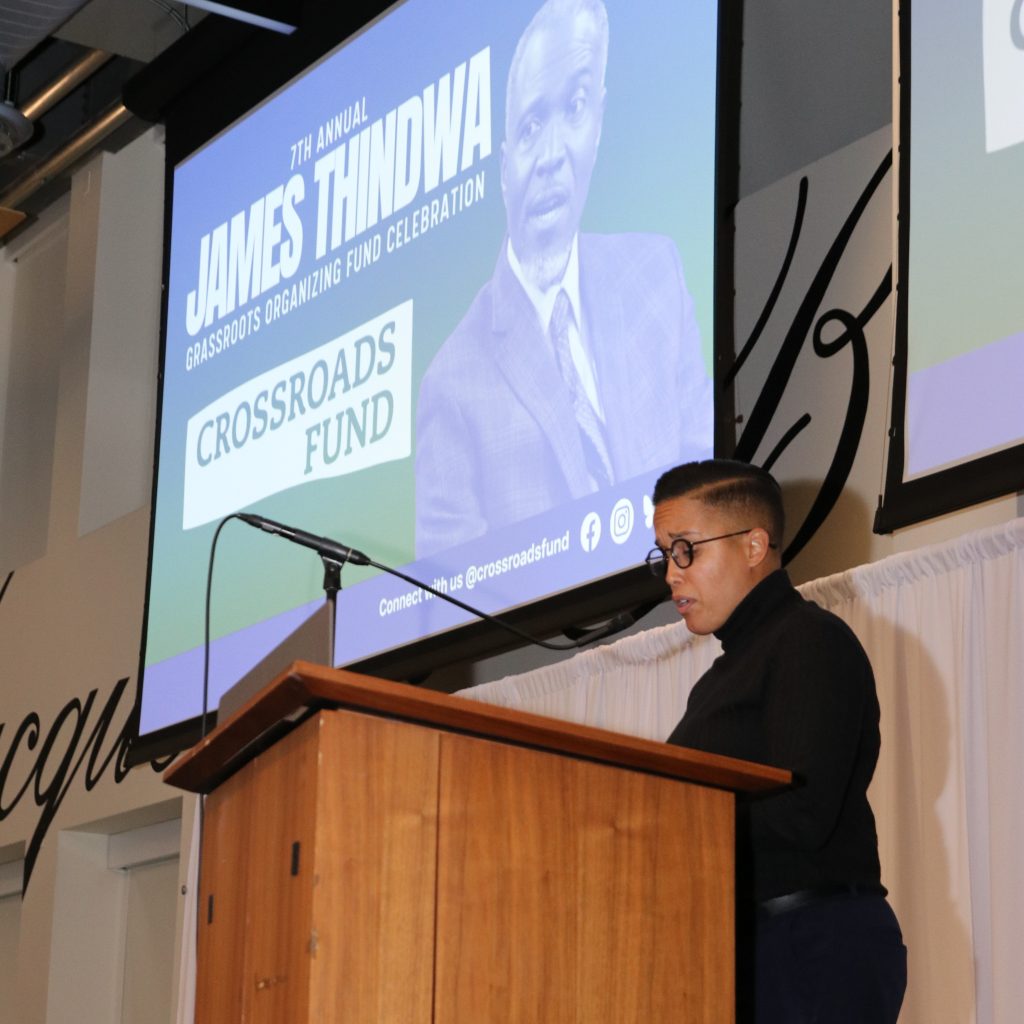
The following remarks were delivered by 26th Ward Alderperson Jessie Fuentes, our guest speaker at the 7th Annual James Thindwa Grassroots Organizing Fund Celebration, held on Wednesday, November 17, 2026. We are pleased to share their reflections and remarks from this special event.
Good evening, everyone.
It is an honor to be here with all of you for the 7th Annual James Thindwa Grassroots Organizing Fund Celebration Event.
Before we begin, I want to recognize the legacy of James Thindwa, whose life and work continue to inspire the movements represented in this room.
James believed that ordinary people have the power to change the world. His organizing touched countless communities and movements, from climate justice and racial justice to workers’ rights and the fundamental right to organize and form unions.
That belief – that ordinary people, when organized, can transform their communities and change the course of history – is one of the most important lessons we carry forward from James’s legacy.
And that brings us to tonight’s conversation.
When we talk about the current administration at City Hall, we have to be honest about what we have learned.
Elections matter. Who occupies the mayor’s office matters. Who sits on the City Council matters. But elections alone do not transform systems. And electing people who share our values does not mean we can afford to stop organizing.
In fact, sometimes the greatest test of a movement is not organizing against an administration that opposes us. When you care deeply about the city of Chicago and its people, accountability means love.
We should acknowledge the challenges, the mistakes, the political divisions, and the work that remains unfinished. But we should also acknowledge the accomplishments.
And there have been meaningful victories.
This administration has advanced some of the most significant worker protections Chicago has seen in decades. We passed paid leave protections and began phasing out the subminimum wage for tipped workers, an issue that disproportionately impacts Black and Latina women.
We have made substantial investments in affordable housing and neighborhood development, including the $1.25 billion Housing and Economic Development Bond and the creation of the Green Social Housing program. We have directed historic TIF surpluses toward our public schools and sister agencies, reopened public mental health facilities, and expanded alternative responses to mental health emergencies through the CARE program.
We have invested in young people through Chicago Youth Works, expanded community violence intervention, and continued building approaches to public safety that recognize safety requires more than policing. It requires opportunity, resources, relationships, and investment in communities that have experienced generations of disinvestment.
We have also seen historic progress in reducing violence, with Chicago recording its lowest number of homicides in more than half a century.
And during the Midway Blitz operation, this administration embodied solidarity and showed us the true meaning of a rainbow coalition.
These accomplishments matter. They matter to workers, families, young people, immigrants, and neighborhoods that have waited a long time to see government invest in them.
But accomplishments do not erase the challenges.
The administration has struggled with budget deficits, navigating the migrant crisis, working relationships with City Council, and translating ambitious policy proposals into effective implementation. Some initiatives have fallen short. Some promises remain unfulfilled. And there are decisions by the administration and City Council that deserve criticism from the very movements that helped bring us into office.
We should never be afraid to say that.
Accountability is not abandonment. Criticism is not betrayal. We can demand more from government while recognizing that progressive policies and investments have made a meaningful difference in people’s lives.
And we must recognize the forces working against progressive change.
We are living in a moment when billionaire wealth is increasingly being translated into political power. Wealthy interests have the resources to influence elections, shape public narratives, fund opposition, lobby elected officials, and undermine policies that threaten their interests.
We have seen this play out right here in Chicago. Billionaire-backed political networks have spent millions targeting progressive City Council allies, opposing elements of the mayor’s budget, and influencing school board elections.
When we fight for affordable housing, workers’ rights, progressive taxation, immigrant protections, and investments in working-class communities, we are not simply debating policy. We are challenging deeply entrenched economic and political interests.
We have woken up the beast.
And those interests are organized. They are well-funded. They are strategic. They understand that power is not something you surrender willingly.
So we have to ask ourselves: Are we building a movement that is equally organized, equally strategic, and prepared for the long fight?
One of the biggest lessons I believe we must take away from our experiences at City Hall is this:
Electing someone is one thing. Building the capacity to govern effectively and dismantle the bureaucracy that intends to watch us fail is something entirely different. Electing a comrade to office is not the end of our mission. It is the beginning.
We have spent decades organizing to get progressive people elected. That work is essential. But what happens after election night?
Do we have the policy expertise? The organizing infrastructure? The coalitions, relationships, and institutional knowledge necessary to implement the changes we promised?
Do we have the capacity to move from demands to legislation, from legislation to implementation, and from implementation to lasting structural change?
Because winning an election does not automatically change the institutions we inherit. Governing requires more than having the right values. It requires the ability to execute: understanding budgets, navigating departments, building relationships, developing policy, negotiating, and creating the infrastructure to sustain change.
We have to build governing capacity alongside electoral power. We need leaders who understand both the movement and the mechanics of government. And we need organizations that can translate our values into policy and hold government accountable.
And importantly, we cannot allow our movement to become confined to City Hall.
We need more progressive elected officials, but we also need stronger community organizations, labor unions, tenant movements, immigrant rights organizations, youth organizers, and grassroots coalitions.
We need people in elected office who are accountable to movements, and movements strong enough to hold those elected officials accountable.
As an alderperson, I know government can be a tool for change. We can pass ordinances, direct resources, protect tenants, invest in affordable housing, and fight for working families.
But none of that happens in isolation. It happens because people like you organize, show up, push, and refuse to accept that the way things have always been done is the way things must remain.
And when we face opposition from those with enormous wealth and political influence, our answer cannot simply be to raise more money or elect another candidate.
Our answer has to be to build more power.
Power in our neighborhoods. Power in our unions. Power in our schools. Power in our community organizations. Power among young people who are learning they do not have to accept the world as it is.
The work of building collective power is not glamorous. It means knocking on doors when there isn’t an election. Developing new leaders. Building coalitions. Showing up for one another when the cameras are gone.
It means understanding that our power is not borrowed from City Hall. It comes from our ability to organize our communities and make those in power respond.
So tonight, I hope we leave with a renewed commitment to the work ahead.
We should celebrate our victories. We should be honest about our shortcomings. We should demand more from those we elect. And we must recognize that the opposition to progressive change will not disappear simply because we win an election.
Movements are greater than any one person in elected office. Movements are our collective of freedom fighters demanding more for working-class people.
And if we do our work right, we will build the collective power, political infrastructure, and governing capacity necessary to change who has power in the first place. We will ensure that when we win, we are prepared to govern and deliver.
That is how we honor James’s legacy.
Thank you.
Jessie Fuentes
26th Ward Alderperson
